
Why Organizational Change Fails — And the Framework to Fix It

Updated: May 11

If anyone tells you that the journey to success is a straight line, they’ve either never done it or are trying to sell you something. Those who have actually rolled up their sleeves and done the work to build cohesive teams know that progress seldom follows a predictable path. This holds true for individual leaders as they experience professional growth and for organizations as they navigate collective change. The real challenge lies in navigating the twists, turns, and bumps along the way.
The Illusion of a Straight Path
“Everyone has a plan until they get punched in the mouth.” — Mike Tyson
Whether you are dealing with unexpected challenges you didn’t ask for or striving to improve, your ability to respond to changing circumstances will define your trajectory. It’s crucial to look as far ahead as you can, and to have the humility to know that you will never be able to see everything coming.
When those curveballs arrive and your quarterly results fall short of expectations, what steps can you take? This is where a solid change management framework can broaden your perspective, increase your field of visibility, and help you align your team on what to do next.
The Beckhard-Harris Change Equation
One useful framework is the Beckhard-Harris Change Equation: (D × V × F) > R. This equation states that individuals and organizations will successfully change only when the combined power of Dissatisfaction with the present reality, the Vision for something better, and the clarity of the First Steps needed to get there is greater than the forces that limit or Resist that change. It serves as a powerful tool for change leaders, emphasizing the balance between what is needed to instigate change and the resistance that inevitably arises.
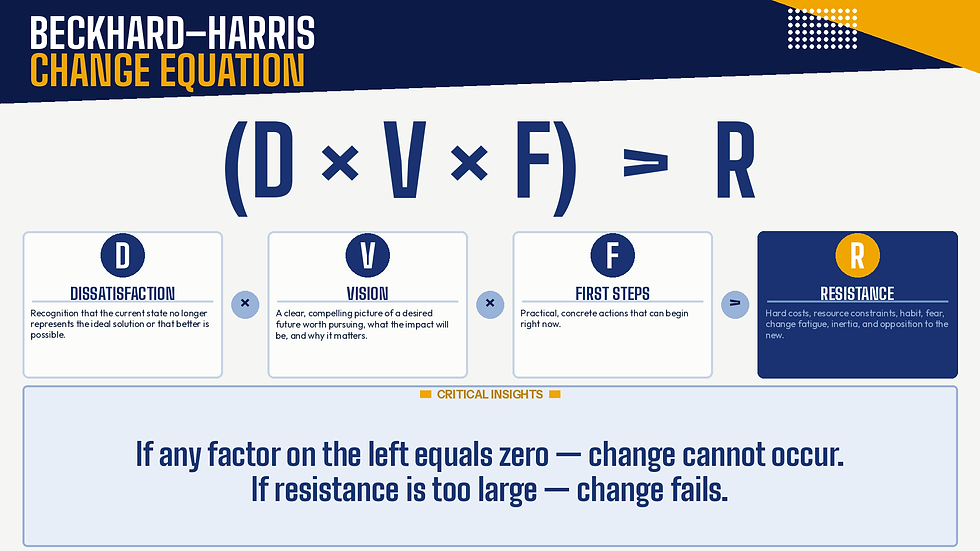
Breaking Down the Equation:
Dissatisfaction (D): The starting point for nearly all change initiatives.
Vision (V): A clear picture of what a better future looks like.
First Steps (F): The actionable steps needed to move toward that vision.
Resistance (R): The forces that inhibit change.
Let’s examine each of these components to understand how they relate to each other and why they matter.
Dissatisfaction: The Catalyst for Change
Dissatisfaction drives the need for change. When existing systems fail to meet evolving expectations (due to shifts in customer preferences, technology advancements, or other factors), it creates the desire for something better. This yearning is more than a simple feeling; it is the catalyst for transformation.
However, when “better” becomes possible, leaders should resist the urge to disparage current or past practices. Organizations live or die based on the collective effort of the people who build them. If your team has built something meaningful that has managed to grow and survive, they have every right to be proud of their accomplishments. They likely value the traditions you’ve built together, and they will defend the practices that got you here. Leaders who regularly throw past practices “under the bus” in an effort to stoke desire for change actually risk increasing resistance to the very change they hope to implement. Past accomplishments must be acknowledged and valued, and positioned as having paved the way for even better practices moving forward.
Vision for Better: Direction Matters
The need for change isn’t merely a reaction to dissatisfaction. It is directional, and it must be focused. Change can flow away from negative stimuli or toward positive ones, depending on how leaders craft the vision for better. A clear vision serves as a focal point: it informs thinking, aligns efforts, and converts dissatisfaction’s negative emotional energy into something constructive by inspiring team members to pursue desirable outcomes rather than simply avoid negative ones.
A compelling vision can emerge from any level within the organization, from senior leadership to entry-level employees. Where it comes from matters far less than what you do with it. You must ensure that it is clear, credible, and engaging. When employees can visualize what a better future looks like, they are far more likely to put in the work to make it happen.
First Steps: From Vision to Action
Vision without action leads to frustration, organizational stagnation, and burnout. But collective action requires process and structure. Clear organization and defined steps allow for better communication and realistic expectation-setting. Without them, even the most inspirational vision will fizzle.
For the people you lead, understanding how the vision will be accomplished reinforces its credibility. It also empowers team members by helping them understand their role in the implementation, and fosters a sense of ownership in both the process and the outcome.
Integration of the Components
For change to successfully occur, all three elements on the left side of the equation (Dissatisfaction, Vision, and First Steps) must be present and articulated effectively. If even one is missing, the momentum for change will stall in the face of inherent resistance.
The Emotional Reality of Change Advocates
Change advocates tend to resonate powerfully with the left side of the equation. For them, a better future is not a distant possibility. It is an emotional reality that lives in the present tense, pushing them to make things happen and inspiring them to recruit others to their cause. Even novice change advocates are capable of generating genuine interest, excitement, and passion for improved outcomes.
However, the ability to successfully harness and coordinate that excitement is what differentiates effective leaders from their less experienced counterparts. The best leaders not only inspire passion for change, they provide the structural framework and resources necessary to channel that energy in ways that are organized, consistent, and sustained over time.
Resistance to Change: Understanding the Forces at Play
Resistance to change is a natural byproduct of human problem solving, and it is deeply rooted in psychology. Ask anyone who enjoys jigsaw puzzles about their hobby and they will tell you it demands effort and creative problem solving. It also offers the satisfaction of visible progress during the building process and accomplishment from the finished result. Once assembled, many puzzlers are reluctant to break it apart and start over. Organizations work the same way. The time, effort, and creativity that went into building and stabilizing the firm, as it exists today, provides fuel for the psychological forces that can prevent it from making the changes necessary to succeed in the future.
This resistance is so consistent and pervasive that researchers have given it a name, The Organizational Immune System, to describe the multilayered set of protective mechanisms that naturally emerge to defend established organizational practices and systems. Factors that can exacerbate this resistance include fear of the unknown, opportunity costs, personal discomfort, and deep-seated beliefs about what drove previous success.
Resistance Behaviors
Narcissism and Gatekeeping
When organizations are successful (or simply manage to survive long enough) leaders and employees can become infatuated with their own way of doing things. When a team narcissistically elevates routine processes, procedures, and industry norms to the level of “unique intellectual property” or “secret recipes,” they lose sight of the context and external factors that played a role in their success. This renders them blind to the assumptions and boundary conditions that must hold true for that success to continue and sets the table for unwelcome surprises they could have seen coming. This pattern is also evident when new ideas and practices are routinely dismissed before they have the chance to be evaluated critically.
Key indicator: New ideas are dismissed without fair evaluation, and internal processes are routinely described as competitive advantages without sufficient data or supporting evidence.
Culture-Driven Stagnation
The evolution from the “elevator pitch” of the 1980s and ’90s to the hashtags and keywords of today reflects not only a shift in professional communication preferences but also a meaningful change in how many business professionals think. When leaders and their teams simplify their understanding of the organization to the point of conflating “what we do” with “who we are,” they create the conditions for cultural stagnation. When leaders and team members fail to distinguish the firm’s Vision (what we do) from its business model, operating model, and people strategy (how we do it), they maximize resistance by ensuring that virtually any change will be perceived as an existential threat to be defended against.
Key indicator: Proposals that change how work gets done generate the same resistance as challenges to organizational identity because there is no longer a clear distinction between the two.
Positional Power and Control
Organizations tend to promote and reward those who combine strong performance with the ability to build relationships and navigate internal systems effectively. At its best, this dynamic fosters the psychological safety needed for employees to innovate and take calculated risks. Left unmanaged, however, it can become a liability; reinforcing a preference for the familiar over the unknown and rewarding those who excel within the current rules of the game rather than those who will challenge and improve them.
When this pattern takes hold at the leadership level, the consequences can be significant. Executives and managers who have built their success on familiar policies, processes, and organizational norms often develop a vested interest in preserving them. Faced with uncertainty or pressure to change, these leaders may lean on proven methods and, consciously or not, use their organizational influence to slow or deflect change rather than engage with the emerging signals, data, and strategic risks that drive long-term performance improvement.
Key indicator: The leaders most resistant to change are often deeply rewarded by the current system, and the organization rarely holds them accountable for it.
Short-Sightedness
People rarely cast themselves as the villain of their own story. For anyone working to overcome change resistance (or to persuade an antagonist to become an ally) the ability to understand the motivations behind resistant behavior is critical.
In its most positive light, resistance to change is usually motivated by a desire for safety and security. It is a homeostatic force for preservation, grounded in inward-looking factors and prior organizational performance. It rarely accounts for external factors associated with the organization’s forward-looking trajectory and competitive environment.
These behaviors also render their practitioners blind to where the organization is heading. They are often unable to see what needs to happen today in order to position the firm for continued success tomorrow. When that happens, decision-making becomes driven by convenience, the need to meet short term profit projections, or personal compensation rather than long-term organizational health.
Key indicator: Decisions are consistently driven by what is convenient, familiar, or personally advantageous today rather than what is needed to position the organization to compete tomorrow.
Heel-Dragging and Malicious Compliance
When the organizational immune system activates, one of the most common responses from veteran resistors is to out-wait undesirable change by moving as slowly as possible until the conditions that motivated it (or the leadership priorities that called for it) become outdated or irrelevant. This behavior is most common in industries and organizations that experience frequent or rapid change.
The employees most likely to display it are those with long organizational tenures and no plans to retire. They’ve watched previous change efforts come and go, and they’ve been conditioned to expect they can outlast whatever the current “flavor of the month” turns out to be.
Robust performance management can successfully counter heel-draggers, but it also creates conditions for a particularly difficult form of organizational dysfunction. “Malicious compliance” occurs when leaders and employees study performance management policies closely, looking for loopholes or conflicting guidance. When successful, malicious compliance enables resistors to do the bare minimum needed to avoid disciplinary action while waiting out the change and providing policy-based cover to follow only the directives that they deem valid.
Key indicator: Compliance is technically present but conspicuously minimal or lacks follow through. Resistors have mapped the gaps in your change process more thoroughly than the people trying to lead it.
Putting It Into Practice
Bringing about meaningful change requires deliberate action. The following principles translate the Beckhard-Harris framework into practical leadership habits:
Honor the past. Don’t tear down the people or practices that got you here. Demonstrate genuine knowledge and appreciation for what was built, even as you work to improve performance and adapt to changing conditions over time.
Lead with humility. No matter how strong your business is, it can always get better. No matter how skilled a leader you are, there will always be opportunities you will miss and pitfalls you didn’t see coming. Approach your leadership like doing the dishes: take a moment to appreciate the empty sink when you’re done, but know up front that there will be more to do tomorrow.
Define the process, provide adequate resources, and set clear performance standards. Role clarity, task definition, sufficient resources, and measurable performance standards go a long way toward mitigating resistance. A logical action plan paired with a well-designed process creates the metrics your organization needs to discourage unwanted behavior, reward results, and maintain focus over time.
Pierce the veil of short-term thinking. Help your team understand what drives the long-term health of the organization, how it affects them personally, and have the courage to be direct. After all, if the goose is allowed to die, it doesn’t matter how many plans we had for the golden eggs we assumed would keep coming.
Demonstrate the durability of your commitments. Countering heel-dragging requires followers to believe that the change you are leading is not the flavor of the month. Build performance standards around the change that can be objectively measured, make performance visible in real time, and administer consequences and rewards fairly and consistently at every level of the organization.
When you encounter malicious compliance, the only way out is through. Identify and confront the behavior while simultaneously working to change the conditions that allow it to persist, starting with yourself. Malicious compliance is often a byproduct of poorly designed or hastily implemented change efforts that leave exploitable gaps. As Charlie Munger said: “Show me the incentive, and I will show you the outcome.” When someone successfully employs malicious compliance, it becomes its own reward until it is addressed directly and the underlying gaps are closed. If your own timeline or decision-making created those gaps, own it and close them.
Moving Forward
As you step into the next quarter, now is the time to evaluate your change strategy. Reflect on the health of each component in the Beckhard-Harris Change Equation and address both sides with equal intention. Whether you are strengthening the factors on the left or mitigating resistance on the right, a holistic approach will carry you further, faster, and allow your team to make the journey with you.
Creating a culture that embraces change requires both clarity and compassion. When leaders balance emotional connection with structured process, they build environments where innovation and transformation are not just possible, they become expected.
The organizations that lead through change aren’t luckier than the rest. They’ve just gotten very good at understanding why change is necessary, identifying where friction lives, and going to work on it.
You can do it. If you want help, let's get to work.
We’d Love Your Thoughts! What strategies have you found effective in managing change within your organization? Share your experiences by leaving a comment on our LinkedIn page or send us an email. Your insights could help others navigate their change journey.
Liked this one?
The next one lands in subscribers' inboxes first.
Additional Resources:
Beckhard, R., Harris, R., (1987). Organizational transitions: Managing complex change
Blomstrom, E. (2018). "Nobody Gets Fired For Buying IBM". But They Should. Forbes.
Etareri (2022). An analysis framework of change management. Medicon Engineering Themes, 3(1), 30-38.
Kelly, J (2023) Follow the Incentives and That Will Tell You Everything. Forbes.
Macauley. Coping with Change: Cents and Sensibility. Wendworks company blog.


